Nothing to Show For It: Four Months of Indie Dev Reflections
Four months ago, I felt the world was full of ideas, full of things that could be done, and I had big hopes. But four months later, I’m almost disheartened, also confused: I don’t know what to do, and I don’t know where the way out is.
Here’s the tone of this little summary:
First, I feel like I’m on the verge of failure. But calming down, this is the most real side of entrepreneurship. I think I haven’t failed yet, still have to keep trying.
Second, this article is not a summary of experiences and lessons. Because my understanding isn’t that deep yet, I can only share what I did and how I felt.
A bit of background
I entered the internet industry in 2005 and mobile internet in 2009, working for over 20 years. As an early designer, I participated in the process of a company going from zero to publicly traded and completed countless projects, accumulating some financial stability.
It’s no exaggeration to say that for the past 20 years, I’ve been itching to do something of my own. Unfortunately, my timid nature and immature conditions stopped me. Even when I had some financial foundation, I still didn’t dare to act.
By the end of 2025, this idea of doing something myself started to germinate again. Indeed, it was AI that gave me the courage to create something.
Before leaping into a solo entrepreneurial journey, I did two things:
Research on the current state of solo entrepreneurship: This research was done through AI. AI provided me with a report based on certain data. It told me that generally speaking, the first 4 to 6 months might have no income at all, and in such situations, only about 1%-3% survive. This research gave me a basic mental preparation.
Personal finance analysis: Based on my current living and consumption level in the US, my financial status can roughly support my ventures for 3 to 5 years. This gave me a basic expectation of the entrepreneurial timeframe.
At the end of March, I quit my job and started exploring.
Four months, four products
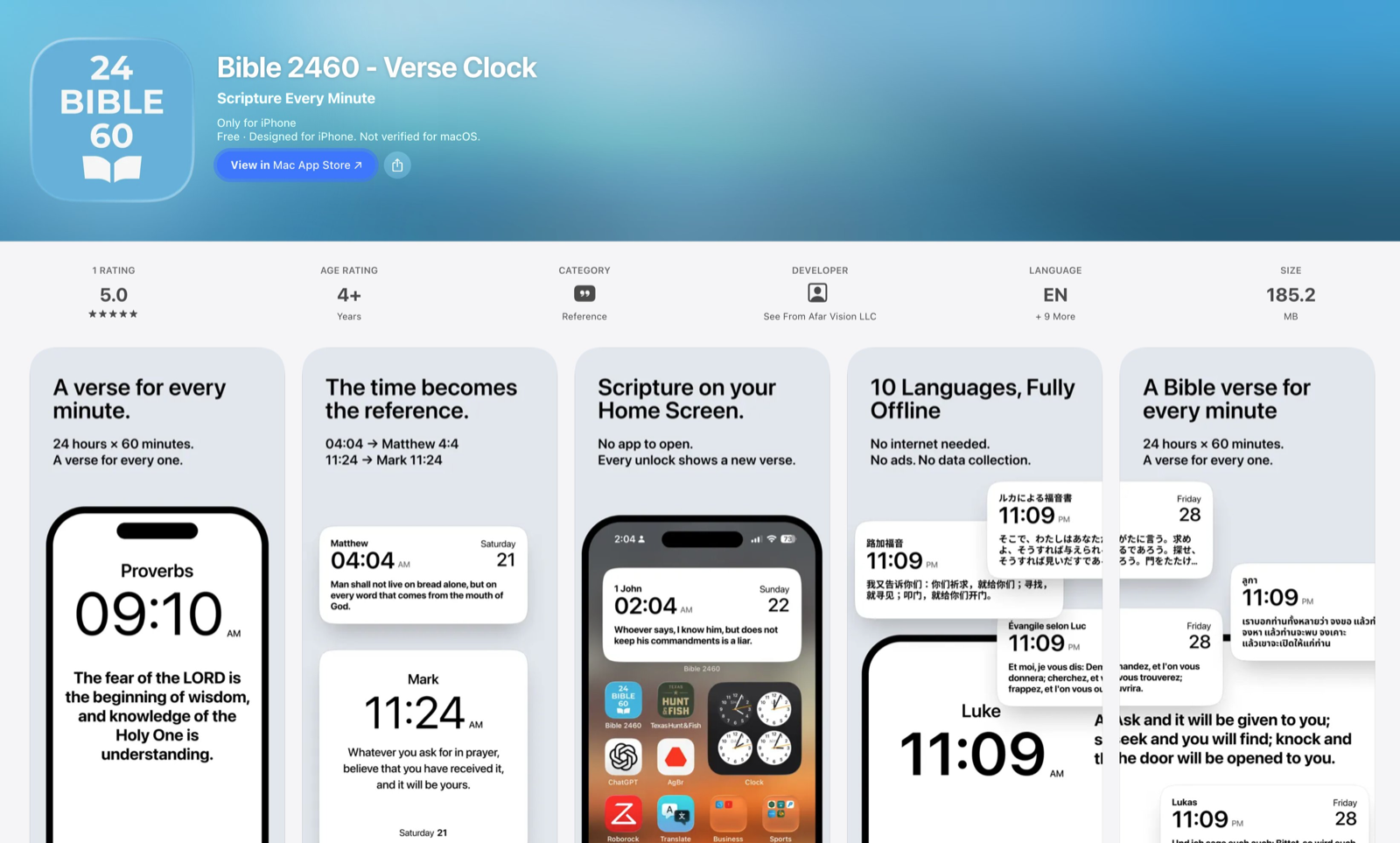
Bible 2460
The first product is a Bible clock - Bible 2460 https://bible2460.com/. It’s a practice product. I’m an Apple fanboy and always wanted to make a standalone iOS App. At the same time, I’m a Christian and have the need to read the Bible. So, this app mainly fulfilled a personal wish, with almost no consideration for paid use, purely for fun, and I felt justified.
Currently, this product has about 600 users, all free users. There are 5 to 10 downloads per day randomly, along with some organic traffic. This might be the one with the “best data performance” among all my products.
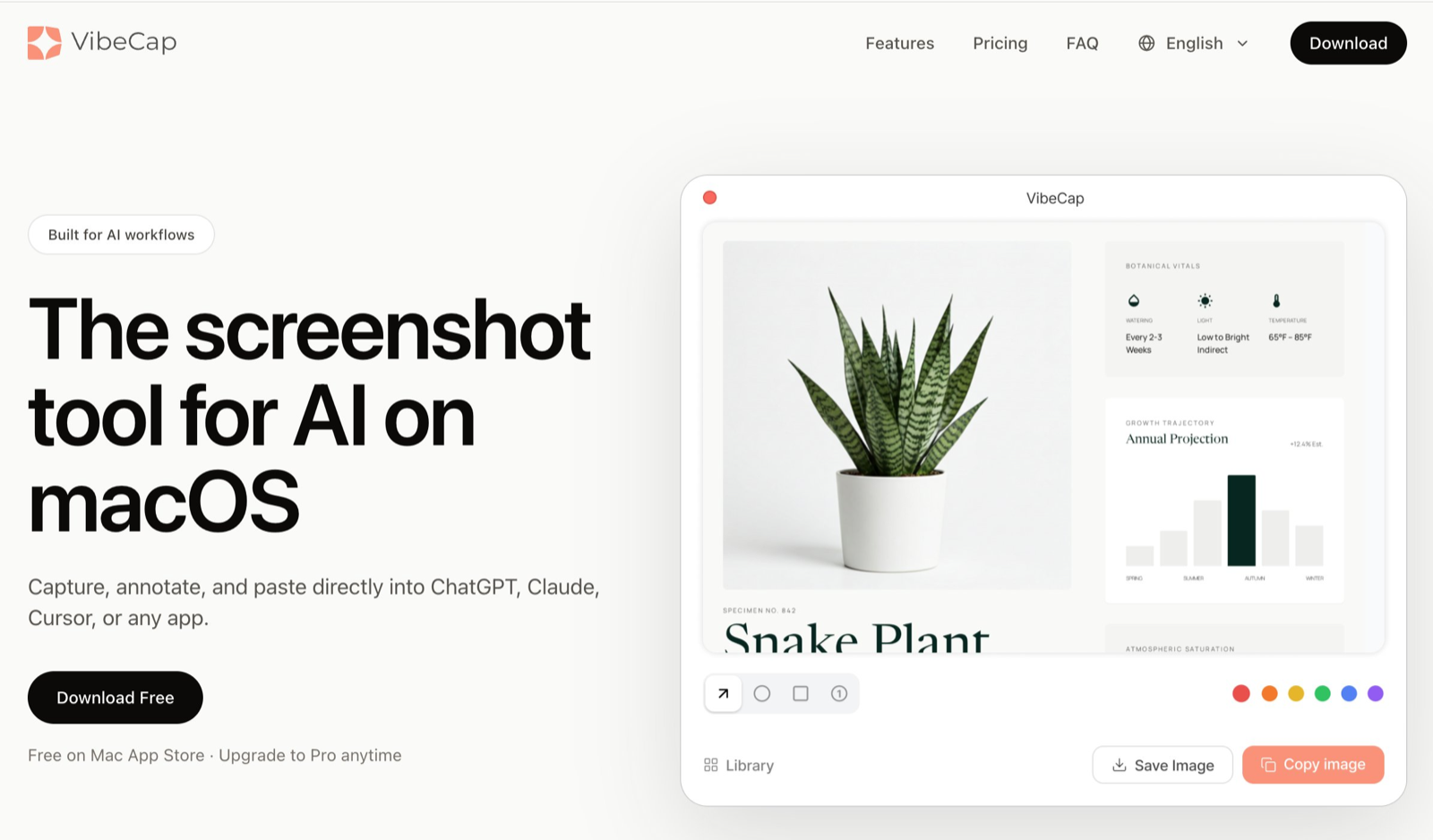
VibeCap
The second product is VibeCap https://vibecap.dev/en/, a screenshot app for AI programming.
In AI Coding, especially for designers, you often need screenshots to communicate details and optimize adjustments with AI.
Apple’s native screenshot tool isn’t very convenient, and VibeCap is a very fast, lightweight screenshot tool:
- You can use the shortcut Command + C to screenshot and copy, then use Command + V to paste directly.
- It supports scheduled automatic cleaning of images.
When I initially launched this tool on the Mac App Store, people actually paid for it, and someone directly bought the $29 Lifetime version. This gave me a lot of hope, or rather, illusion.
After updating a few versions, there’s basically been no noise.
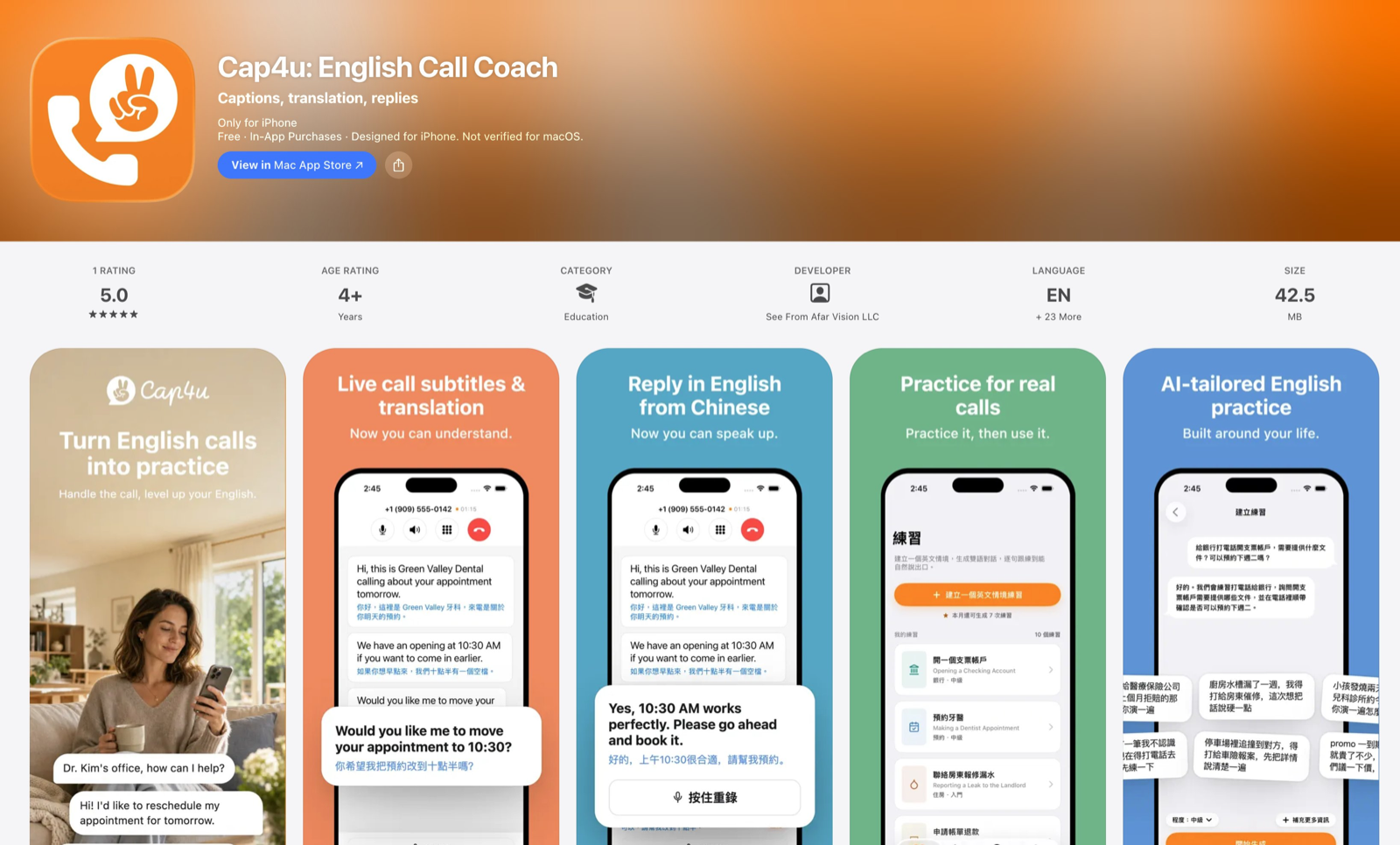
Cap4u
The third product is the heaviest I’ve made — Cap4U https://apps.apple.com/us/app/cap4u-english-call-coach/id6769973855, also a very idealistic product.
I immigrated to the US in 2022. Because my English isn’t good enough, I faced many challenges in life. Many of my friends around me also have the need and desire to improve their English.
At the same time, living in the US, dealing with phone calls is a very practical issue — not understanding English calls and not knowing what to say.
So, this product mainly offers the following features:
- AI subtitle translation: Helps users understand what the other party is saying first.
- Native translation: Uses AI to translate a user’s native language into corresponding English, letting users know how to express themselves.
- Practice in advance: Allows users to prepare customized practice for a specific thing in advance.
I can’t conclude yet and say it’s a failed product, because I haven’t done any formal promotion. But I think it should also be a relatively difficult product to grow, as essentially it is a counter-intuitive product, requiring users to have very strong motivation to improve English.
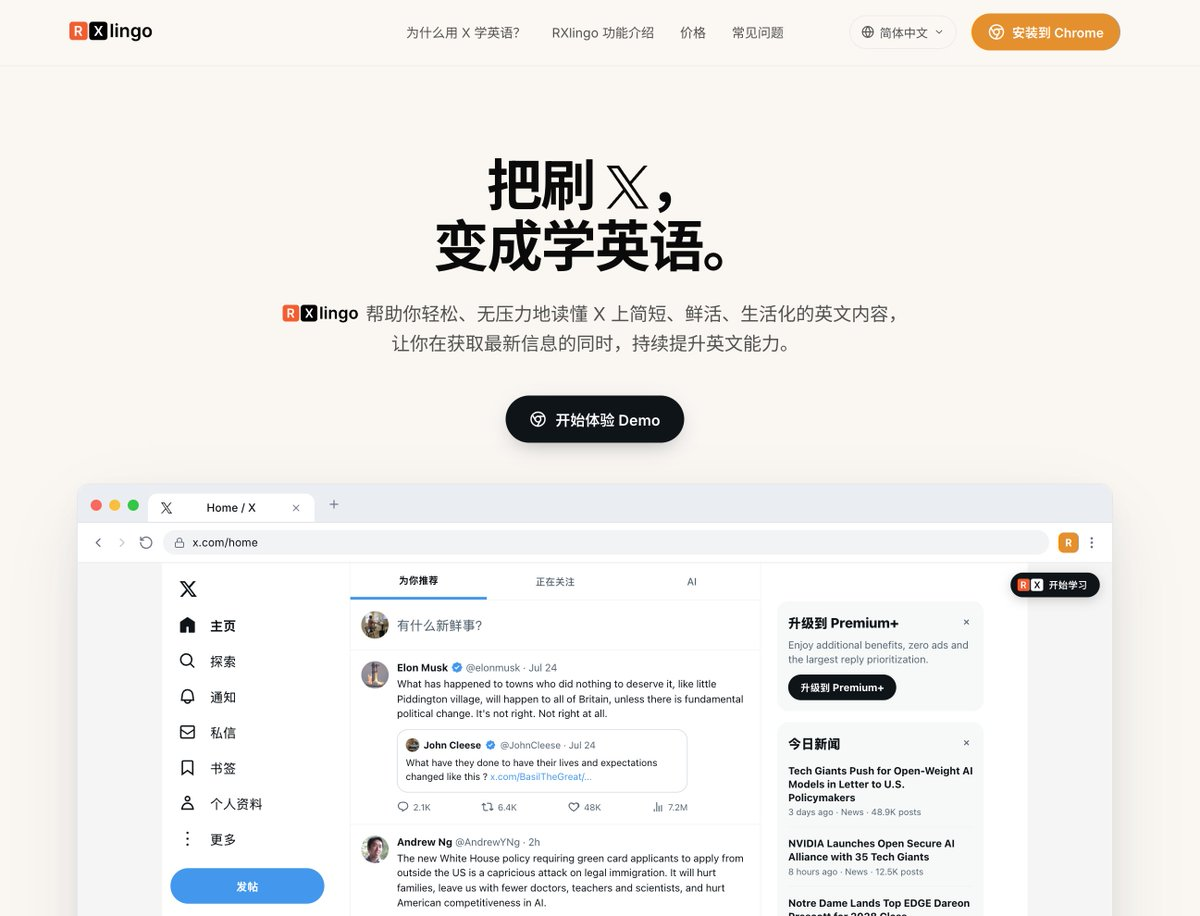
RXlingo
The fourth product is called RXlingo https://rxlingo.com/, which is actually quite an interesting product.
At that time, I was releasing Cap4U and submitting it for App Store review. During breaks when I had nothing to do, a thought suddenly came to me to make a browser extension.
This was actually a product I found relatively easy and comfortable to create. Its concept is simple, but users might not be sold on it.
I owe thanks to a friend here. Although we don’t know each other, he’s also an independent entrepreneur.
At the time, he suggested, “Try posting videos for a month.”
It was from his suggestion that I got inspired to start posting videos.
Currently, my product has about 100 installs, but income is still zero.
Earlier on Reddit, I did some promotions targeting users in Japan and Korea. The costs were relatively reasonable, about $0.4 to $0.5 per click. But according to my business model, with the current conversion rate, it’s definitely at a loss.
Also, I’ve consistently recorded about four or five videos, posted them on Xiaohongshu, Douyin, Kuaishou, and WeChat Video Channels, and successfully attracted some followers, getting some likes and shares. Although these numbers might seem insignificant compared to some big IPs, personally, I think it’s a pretty good start.
Not So Profound Reflections
That’s the general product introduction, now let me talk about some of my feelings and reflections.
Stepping Out of My Comfort Zone, Doing What I Don’t Want to Do
This is actually a principle I learned about seven or eight years ago: the things I don’t want to do and find difficult are often the very things I should be doing.
I’m an introverted person with a lot of insecurities. From 2015 to 2019, when I led a team, public speaking was something that drove me crazy and I couldn’t face it. But later I broke through, and not only can I speak relatively freely in front of an audience, but I also enjoy it.
Now running my own company, I need to step out of my comfort zone, specifically in two areas:
Marketing and promotion: This requires me to appear on camera to record videos. This used to be something I really didn’t want to do. In the past, in the videos I recorded, I often felt like my tongue was tied. But there’s no other way, I have to do it myself.
Communicating with people: Talking to people of different ages around me—I can’t just call them “users.” Talk about life, about their feelings, introduce and recommend the product to them. Even though I’m clumsy with words, I still have to keep doing it.
If I want to make a living with a one-person company, this is the comfort zone I have to leave.
I don’t think I’m making things hard for myself. Instead, I feel that through the experience of running a one-person company, I am becoming more complete in my character and personal qualities.
One-Person Company Entrepreneurship Requires a Comprehensive Set of Skills
Although there are powerful tools like AI, which can even be considered teammates, starting a one-person company still requires a comprehensive set of skills from an individual:
- Financial and time management: You need to manage your finances and also manage your time well.
- Family and balance: Especially if you have family and kids, even if you invest a lot into your venture, you can’t neglect family and children, otherwise a successful venture is meaningless.
- Physical and mental health: Take care of your body, because if your health goes, you have nothing. This also includes mental health, and having a group to communicate with is necessary.
Regret Not Doing Something Sooner
What I regret not doing sooner is establishing my own social channels.
Although I’ve been writing a public account for 10 years, I didn’t deliberately increase my followers, just wrote more casually. After 10 years, I only have 1,500 followers. On platforms like Xiaohongshu, I was just a spectator. It wasn’t until a month ago, in July, that I began to consciously expand my social channels.
Although progress is slow, there are still some advances:
- For example, on my public account, after spending some time, my followers grew from 1,500 to about 2,500.
- Additionally, previously shared tweets brought me nearly 500 follows.
Why do this? Because the cost of distribution is just too high.
To give a simple example, for my Cap4U iOS App, when testing App Ads, with a budget of $2 per click, I barely got any exposure, and even with clicks, there were no installs.
On the other hand, for RXlingo, I posted several videos on Xiaohongshu and attracted many followers asking how they could start experiencing it.
In the age of AI, distribution is more important than development. This is a well-known fact, but only after walking the path myself do I have such a deep understanding.
Communicate More with Family
When starting a “one-person company,” I seriously discussed my ideas with Yanbing, and the kids (the eldest is 16 and the second 11), telling them why I wanted to do this. In fact, I wanted to share with the kids, letting them know my thoughts and approaches, giving them a basic understanding and concept of entrepreneurship.
Over the past four months, Yanbing, without saying, and even the two kids were very concerned about my progress. I told them honestly that I occasionally receive a little user payment, but most of the time there is no income, which worried them. My son even asked how much money we had left, and of course, I couldn’t tell him the exact figures. A few days ago, during a chat, my son asked directly, “Why don’t you get a job?”
I also told him that right now, getting a job might be the easiest option for me, but finding a good job isn’t too easy either. Moreover, in the long run, I’m unlikely to work for others forever, as this doesn’t hold long-term value for me. So, despite having no income now, I still need to keep exploring.
Through such communication and sharing, I feel that even if later on I really don’t succeed and have to return to the workforce, this experience would not only belong to me but our whole family.
Disconnect Between Faith and Entrepreneurship
Initially, I was full of confidence, with AI, I felt invincible. As a Christian, I didn’t feel any different from ordinary people when it came to entrepreneurship, investing fully, working day and night. I even felt like my development work didn’t need faith, and had nothing to do with it, they were entirely disconnected.
When I reached such a state, I actually found myself moving further away from my faith and my relationship with God. The Bible says, “If anyone loves the world, love for the Father is not in them.” I’ve always had this understanding and am often reminded of it. But for me, being in that state, it was hard to put into practice.
Around the fourth month, I received some reminders, including from Yanbing. She told me I needed to pray, to entrust. Initially, I even half-jokingly said, “Why pray when you have AI? I think AI can solve all these problems.”
That statement isn’t wrong, AI might be able to solve technical problems. But issues with my mindset, faith, perspective, I feel AI can’t solve; whether my thoughts are clear and sober enough, AI can’t address that either.
So by the fourth month, a verse kept coming to mind. It’s from when Jesus was resurrected and Peter and others went out fishing and said, “We’ve worked hard all night and haven’t caught anything.” This resonates exactly with my current state—I’ve worked hard all day, for four months, and haven’t gained anything.
Peter’s faith was evident when Jesus told him to “Put out into deep water, and let down the nets for a catch” (Luke 5:4), and Peter did so. Peter was a fisherman, a very professional one; Jesus was not a professional and arguably knew nothing about fishing. Yet Peter, a professional, was willing to put aside his knowledge and method, following the guidance of a non-professional, which requires immense faith.
So for me, how do I now return to God? I must also let go of my insistence, seek God’s guidance, including what to do next. I try to avoid falling into a “prosperity gospel,” but undeniably, I do want positive feedback, and I believe I can pray for that.
But my core, most important purpose isn’t just about success. In other words, if I don’t succeed, I believe I can accept it. I hope more so in this process, I can rediscover God.
On August 17th, it was the first day of school for my child, starting sixth grade. He’s attending a Christian school. During the opening ceremony, we listened to a pastor’s sharing.
The pastor’s words were simple, but one sentence struck me deeply, even though I’ve heard it many times before. The pastor said, the hope is that the children’s learning and growth at this school isn’t just for themselves, but more so to glorify God; the knowledge and abilities they acquire are also to glorify God.
This made me think of myself: my education, my knowledge, my abilities should also glorify God.
Lastly, it wasn’t all for nothing
First, I figured out the basic concepts and processes of AI programming:
- Managing and using GitHub.
- How to build a harness, and how to write, reference, or create your own Skills.
- Doing automated testing.
- Setting up Mixpanel data tracking.
- Launching campaigns.
I also started doing some marketing and social channel promotion, gaining a few followers.
On Xiaohongshu, I also got a bit of feel for making content, with each post getting tens to hundreds of saves and likes.
Lastly, my skin got thicker. 😄